Fine-Tuning vs. Retrieval-Augmented Generation for Multi-Hop QA
Type: Natural Language Processing & LLMs
- Fine-tuned Qwen2.5-7B-Instruct with QLoRA (ranks 8/16/32) and built a retrieval-augmented generation pipeline with FAISS and BGE embeddings, evaluating both independently and combined on HotpotQA’s multi-hop question answering benchmark against a fixed 150-question set.
- Found that fine-tuning alone produced no exact-match improvement (67% of predictions changed, but answer content stayed similarly accurate), while retrieval alone lifted exact-match accuracy by 22.7 points. Combining both produced a 30.7-point lift, exceeding the sum of either technique alone, showing fine-tuning and retrieval are complementary rather than redundant.
- Diagnosed the mechanism behind the synergy: fine-tuning shifted the model toward terser, more literal answer extraction and reduced unwarranted “unknown” abstentions, which compounded specifically with retrieved context rather than improving factual recall on its own.
Tools: Python, Hugging Face Transformers, PEFT/QLoRA, TRL, FAISS, Sentence-Transformers, PyTorch, Google Colab
*Not available for review yet.
Patch-Based Artifact Analysis in AI-Generated Images
Type: Deep Learning & Multimedia Forensics
- Designed an unsupervised patch-level framework to detect fine-grained artifacts and distinguish real images from AI-generated content. Integrated patch-based feature extraction with three deep clustering architectures (DCN, DCN-CAE, and DCEC) to discover recurring generative patterns without relying on labeled data.
- Evaluated the models on FFHQ, StyleGAN2, and Stable Diffusion XL datasets. The DCN-CAE model achieved the strongest cross-domain separation with a Silhouette Coefficient of 0.732. The DCEC model successfully isolated domain-specific generative artifacts and produced the most semantically pure clusters while maintaining near-complete cluster utilization.
Tools: PyTorch, TensorFlow, Keras, Deep Clustering (DCN, DCEC), Convolutional Autoencoders, t-SNE, scikit-learn
*Not available for review.
Customer Churn Prediction in Telecommunication Industry
Type: Machine Learning & Data Mining
- Developed predictive classification models using historical customer data to identify users likely to leave their service provider, helping telecommunication companies improve retention strategies and reduce financial losses.
- Implemented and evaluated Decision Tree, Random Forest, and Gradient Boosting algorithms. The Gradient Boosting model achieved the highest overall accuracy (80.08%), while the Random Forest model provided the highest F1-score (0.63) for the practical detection of at-risk customers.
Tools: Python, Scikit-learn, Predictive Modeling, Data Preprocessing, Data Visualization
*More details here.
Bloomind Garden (HCI Project – First Place)
Type: UI/UX & HCI
- Designed a user-centered mobile application that visualizes positive memories as a growing digital garden to promote reflection and emotional well-being.
- Developed and evaluated a high-fidelity interactive prototype following core HCI principles. The project won First Place at the CS Project Fair.
Tools: HCI principles, Prototyping, User Research, UI Design
*More details here.

CUDA Bitonic Sort
Type: Systems & Parallel Programming
- Implemented Bitonic Sort in both C (CPU) and CUDA (GPU) to evaluate performance on large datasets.
- Designed experiments to measure speedup across different input sizes and analyzed when parallel execution outperforms sequential sorting.
Tools: C, CUDA, Performance Analysis
*More details here.
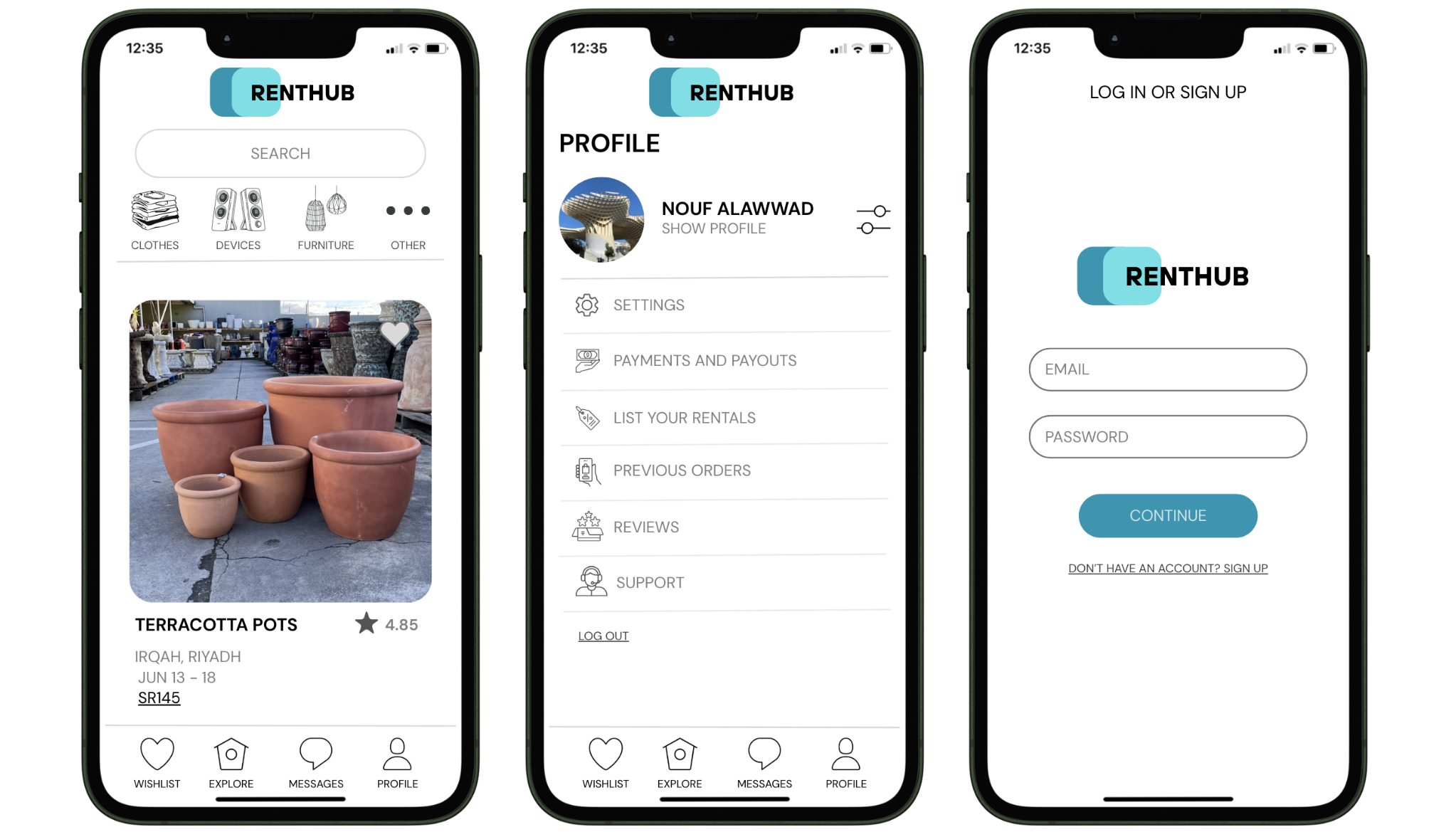
RentHub: Peer-to-Peer Rental Platform
Type: System Design
- Designed a peer-to-peer rental platform that allows users to list, browse, and rent everyday items.
- Defined core system flows including authentication, search, booking, payments, and reviews, and documented system and testing plans.
Tools: System Design, UML, Documentation
*Not available for review.